What Is a Grease Tank Truck? A Guide to FOG Collection
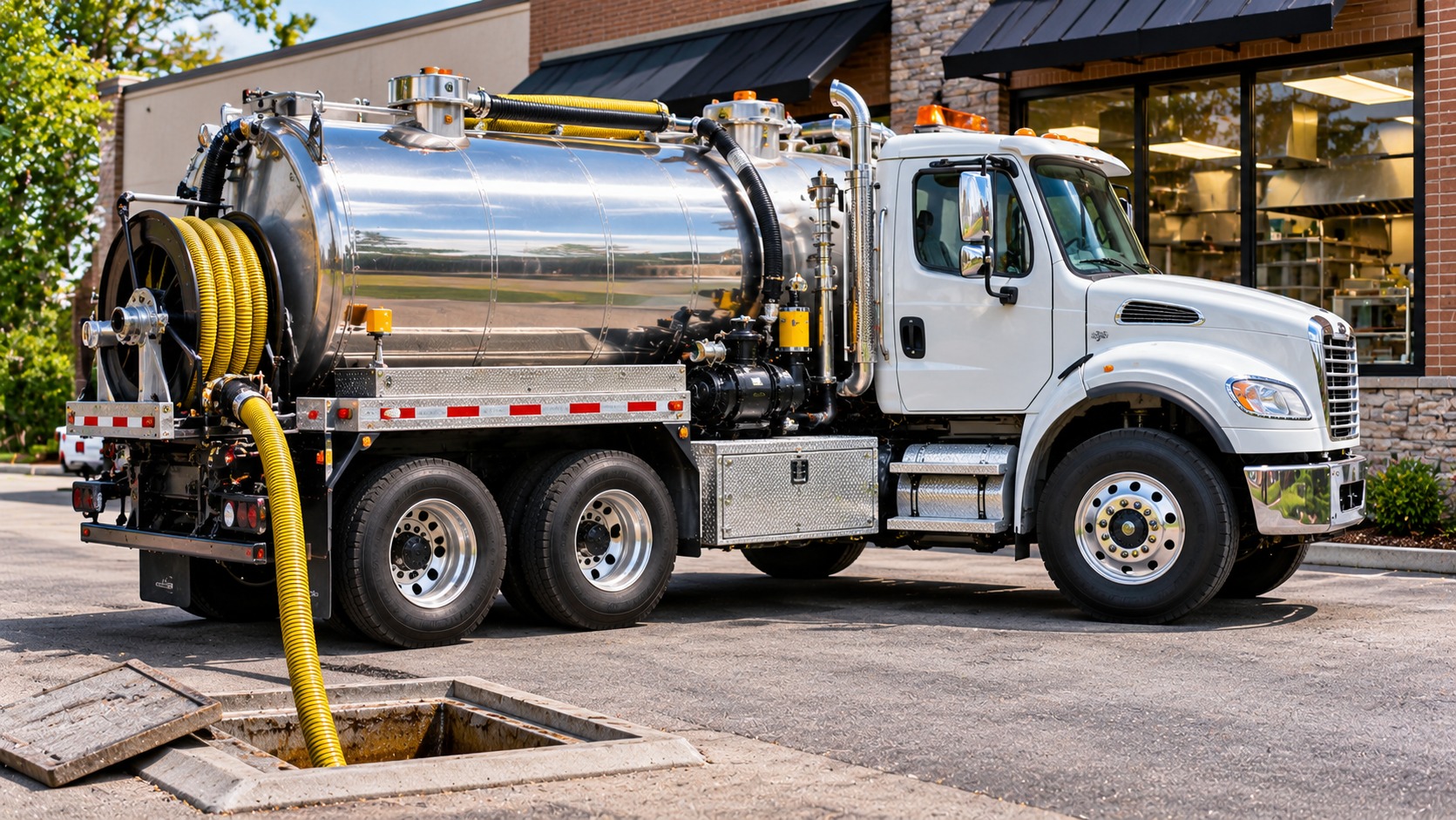
A grease tank truck is a vacuum truck built to collect, haul, and unload fats, oils, and grease (FOG) from restaurant grease traps, interceptors, and commercial kitchens. Without regular pumping, FOG builds up in sewer lines and causes blockages, overflows, and fines. KeeVac Industries builds custom grease trucks sized to your route, your trap volumes, and your chassis.

What Is a Grease Tank Truck?
A grease tank truck is a vacuum truck that pumps fats, oils, and grease from restaurant grease traps and interceptors into a sealed onboard tank, then hauls the load to an approved disposal or recycling facility.
It is also called a grease vacuum truck, grease pump truck, grease trap truck, or FOG truck. Restaurants, hotels, hospitals, schools, and food processing plants are regular customers, which makes grease trap servicing a recurring route business.
What sets it apart from a septic or general vacuum truck is the material. Grease is thick, stiffens as it cools, and goes to a different destination, so pump selection, hose choice, valves, and tank finish all matter more.
Core Components of a Grease Tank Truck
Every grease tank truck is built around six components. This table shows what each one does and what to specify.
| Component | What it does | What to specify |
|---|---|---|
| Storage tank | Holds collected FOG until disposal | Aluminum for payload or steel for durability, sized to route volume |
| Vacuum pump | Creates the suction that draws thick grease through the hose | Rating matched to trap size and how thick the grease runs |
| Hoses and reels | Reach the trap without moving the truck and speed up each stop | Length for site access and bore for thick material |
| Valves and discharge | Control unloading at the disposal site | Rear or side discharge with flow control |
| Overfill protection | Keeps liquid and grease out of the pump | Float or shutoff that works with thick material |
| Pressure and vacuum relief | Keeps the tank within its design limits | Valves rated for the tank and pump |
The pump sets the pace of every stop, and KeeVac pairs its builds with Masport vacuum pump systems. Keep the pump and tank operating manuals with the truck for service schedules.
Safety hardware matters just as much. Pressure and vacuum relief valves protect the tank and pump if pressure or vacuum goes beyond design limits.

How Does a Grease Tank Truck Work?
A grease tank truck works by running a vacuum pump that lowers the air pressure inside a sealed tank, so atmospheric pressure pushes grease through the hose and into the truck. The operator unloads the tank at an approved facility through the discharge valve.
A typical service call follows seven steps, and skipping one usually shows up later as a failed inspection, a callback, or lost vacuum.
- Arrive and set up. Position the truck at the loading area or access point, set the brake, engage the power take-off, and keep the hose path clear of traffic and kitchen doors.
- Assess the trap. Open the lid and measure the floating grease and settled solids so the pump-out is logged against the local cleaning rule.
- Connect the hose and build vacuum. Attach the hose to the intake valve, confirm tight couplings, and start the vacuum pump so grease flows into the tank.
- Pump out the full contents. Remove the floating grease, the water, and the settled solids, not just the top layer, because a partial pump-out leaves the trap to refill quickly.
- Inspect and restore the trap. Check baffles, lids, and inlet and outlet fittings for damage, then replace the baffles and close the trap.
- Secure the truck and record the job. Close valves, reel in the hose, and complete the pumping receipt that many local FOG programs ask restaurants to keep.
- Deliver the load. Haul the load to an approved disposal or recycling facility and unload through the discharge valve.
Where Collected Grease Goes
EPA sorts FOG at food service establishments into two groups: yellow grease and grease trap waste. Yellow grease comes from used cooking oil and is often collected for resale or reuse in tallow, animal feed supplements, and fuels. Grease trap waste is the material pumped from traps and interceptors, and it goes to an approved disposal or processing facility.
Route efficiency depends on how quickly the crew gets from step one to step six, which is why hose reel speed, valve placement, and pump size have a direct effect on stops per day.
Why Grease Trap Pumping Keeps Sewers Flowing
EPA’s Report to Congress on sewer overflows found that grease from restaurants, homes, and industrial sources is the most common cause of reported sewer blockages, at 47 percent. Grease solidifies in pipes, cuts flow capacity, and eventually blocks the line.
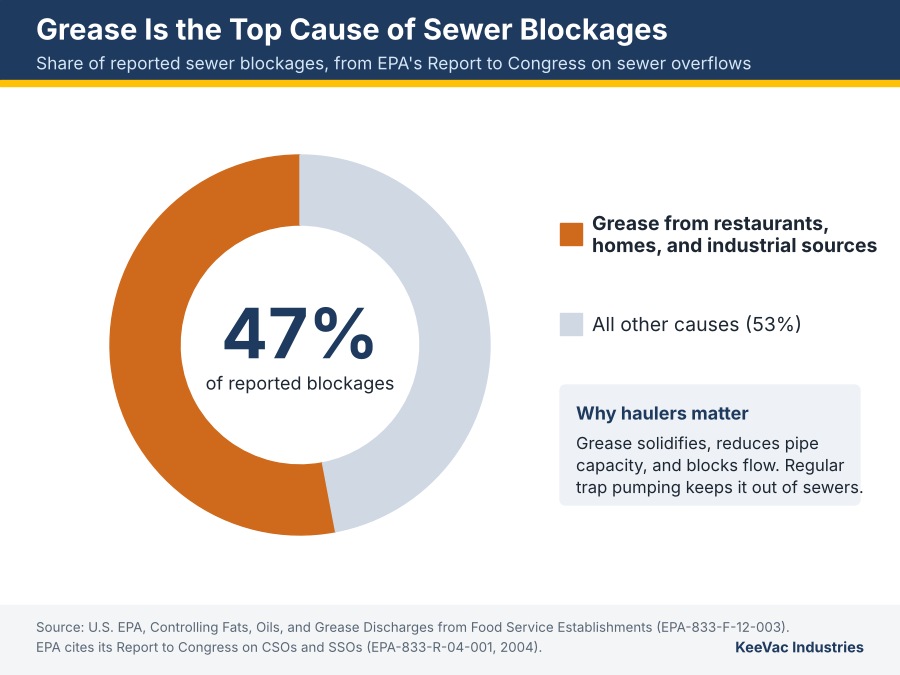
Source: U.S. EPA, Controlling Fats, Oils, and Grease Discharges from Food Service Establishments
How Often Do Grease Traps and Interceptors Need Pumping?
Local rules decide the schedule. Many municipal ordinances require a full pump-out when floating grease and settled solids reach 25 percent of the liquid depth, and some add a fixed interval as well. One example ordinance requires a full pump-out at the earlier of every 90 days or when 25 percent of the wetted height holds grease or solids.
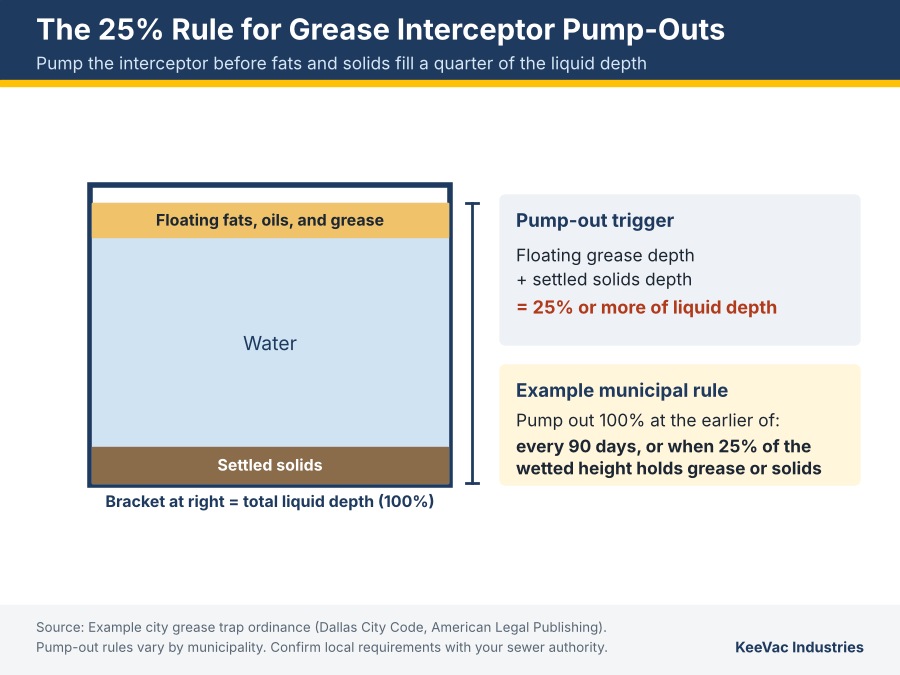
Source: Example city grease trap ordinance, American Legal Publishing
Because trap owners must show pump-out records, many food service customers schedule recurring service, which gives haulers steady routes and makes truck uptime the key to profit.
Grease Tank Truck vs Septic Truck vs Standard Vacuum Truck
A grease tank truck is configured for thick FOG, while a septic or standard vacuum truck is configured for thinner waste. Some operators run a dual-purpose build, and KeeVac’s septic vacuum tank builds cover the septic side of the fleet.
| Factor | Grease tank truck | Septic or standard vacuum truck |
|---|---|---|
| Material hauled | Thick FOG that stiffens as it cools, plus food solids | Septage or thinner liquid waste |
| Pump and hose | Sized and specified for thick material | Sized for water-like flow |
| Typical customers | Restaurants, hotels, hospitals, schools, and food plants | Homes, septic businesses, and portable toilets |
| Where the load goes | Approved grease disposal, recycling, or rendering facility | Licensed septage treatment facility |
| Records | Pumping receipts often required by local FOG programs | Disposal records vary by jurisdiction |
What Services Do Grease Tank Trucks Provide?
A grease collection truck earns revenue across several service types. The most common are:
- Restaurant grease trap pumping: the most frequent use, driven by local rules that require regular cleanings
- Commercial interceptor cleaning: large interceptors at hotel kitchens, hospitals, and institutional kitchens need high-capacity trucks
- Yellow grease collection: used cooking oil recovery uses similar trucks and routing, and many operators run both under one fleet
- Emergency FOG removal: sewer backups and blockages caused by FOG call for quick deployment
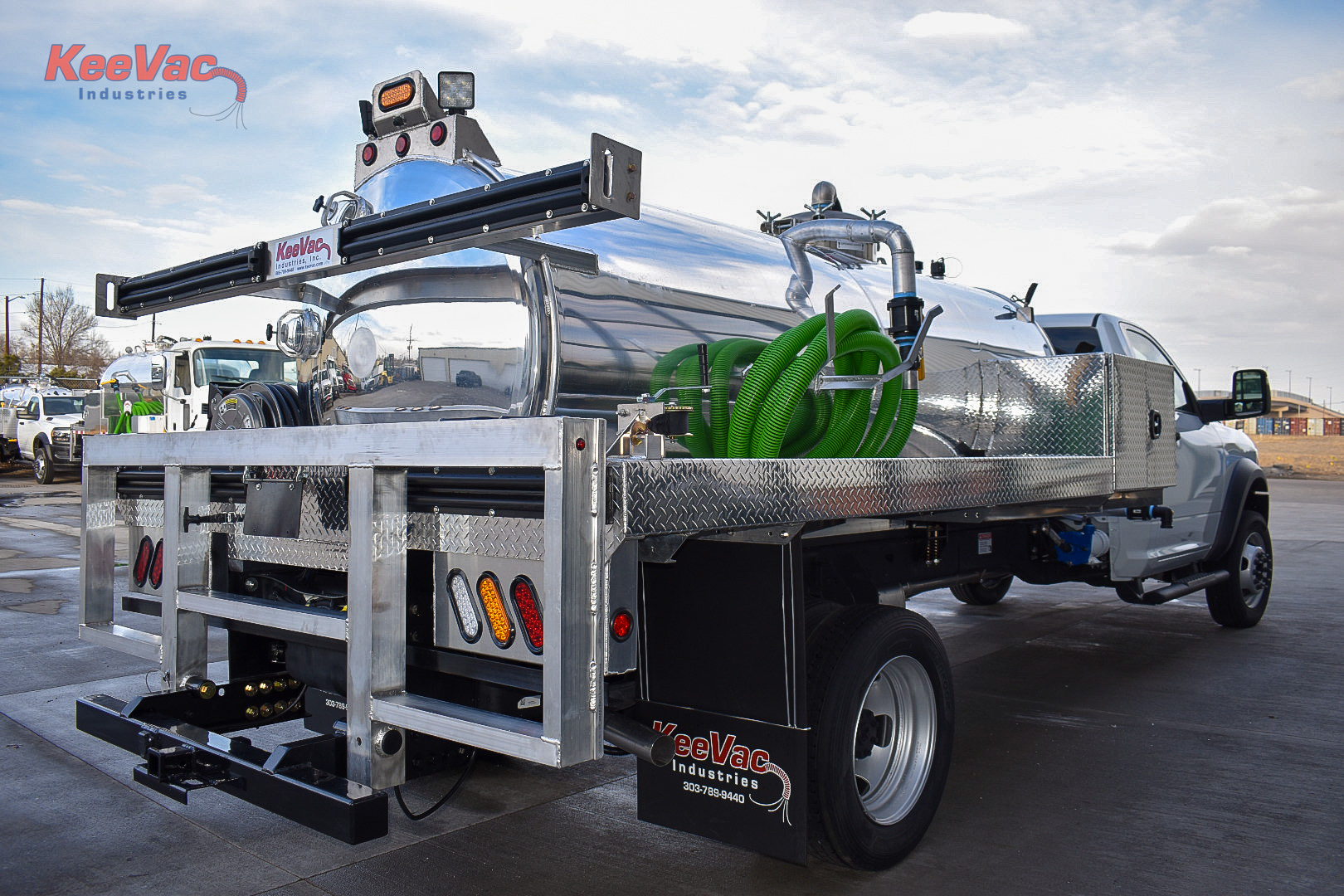
Grease Tank Truck Sizes, Pumps, and Chassis
The right grease tank truck matches tank size to route volume, pump rating to trap size, and chassis to payload. Spec all three together, because a mismatch in one limits the others.
Tank Capacity
Tank capacity sets how many stops you finish before unloading. KeeVac builds tanks from 1,000 to 4,000 gallons. Tight urban routes with nearby disposal suit 1,000 to 2,000 gallons, which keeps vehicle weight and fuel use lower. Long routes with limited disposal options suit 3,000 to 4,000 gallons, which cuts trips to the disposal facility.
Plan weight before capacity. Water weighs about 8.34 pounds per gallon. Grease is lighter than water, but pumped trap waste includes water and solids, so water-equivalent weight is a safe planning figure for the chassis.
| Tank size | Water-equivalent full load | Typical route fit |
|---|---|---|
| 1,000 gallons | 8,340 lb | Tight urban routes with nearby disposal |
| 2,000 gallons | 16,680 lb | Mixed restaurant routes |
| 3,000 gallons | 25,020 lb | High-volume routes with longer hauls |
| 4,000 gallons | 33,360 lb | Long routes with limited disposal access |
Pump Configuration
Match pump output to your typical trap size and how thick the grease runs. An undersized pump drags out heavy jobs, and an oversized one adds strain and cost on light jobs.
Chassis Options
KeeVac builds grease trucks on new and used chassis from Ford, Chevrolet, Ram, International, Peterbilt, Freightliner, Mack, Isuzu, and Kenworth. Aluminum tanks save weight for more payload, and steel adds durability, so match the material to your payload and terrain.
For small traps with tight access, compact pump-out carts can be a better fit than a full truck.
Regulatory Compliance
A grease truck must meet federal DOT weight and safety rules and any state and local environmental rules for hauling FOG. Many municipalities also require licensed haulers and pumping records, so confirm local requirements before you start a route.
How Much Does a Grease Tank Truck Cost?
A grease tank truck’s price depends on tank size, tank material, pump package, chassis, and options, so the most reliable number comes from a quote on your exact specification.
| Cost factor | How it affects the quote | What to decide |
|---|---|---|
| Tank size | More capacity needs more material, a stronger frame, and a heavier chassis | Gallons per typical route, not the largest job |
| Tank material | Aluminum and steel differ in price, weight, and durability | Payload needs and expected service life |
| Pump package | Larger or higher-rated pumps cost more but move thick grease faster | Output matched to trap sizes |
| Chassis | New or used, light-duty or heavy-duty, and brand all change the total | Axle ratings, mileage, and fleet standards |
| Options | Hose reels, safety rails, and discharge systems add to the build | Only the equipment your routes require |
Many buyers spread the cost over time, and equipment financing can structure payments around your cash flow. Compare the same tank size, pump, and chassis across every quote so you are judging like with like.
|
Ready to spec your grease truck? Choose a tank from 1,000 to 4,000 gallons and a pump package matched to your trap sizes and route volume. KeeVac builds it on the chassis your payload needs.
|
Grease Tank Truck Maintenance and Parts
Grease stiffens as it cools and clings to valves and hoses, so a short routine after each job protects the pump and keeps the truck on its route.
- After each job: flush the hose and clear the valves and fittings of grease before it hardens
- Daily: check pump oil, inspect hoses and gaskets, and confirm overfill protection moves freely
- Weekly: inspect lid seals, tank welds, and hose reels, and grease the fittings
- Seasonally: follow the pump maker’s service schedule and review relief valves before cold weather
Worn hoses, seals, and valves are easy to replace through the KeeVac Parts Department, which keeps downtime short.
KeeVac’s truck maintenance resources outline inspection routines you can adapt to your fleet.
Why Choose KeeVac for Your Grease Tank Truck?
KeeVac configures the tank, pump, hose reels, and discharge valves around how your crew works, and every build is held to a consistent fabrication standard. See the range of custom-built FOG collection trucks for model-specific build options.
If a stock layout is close but not exact, custom-engineered vacuum builds let you adjust the equipment to your route instead of changing your route to fit the truck.
Browse KeeVac’s full equipment lineup to compare septic, portable restroom, and slide-in options.
Questions about tank sizing, chassis, or lead times are easiest to answer in a conversation, so talk with a truck specialist about your routes.
Grease Tank Truck FAQs
What is a grease tank truck used for?A grease tank truck collects, transports, and unloads fats, oils, and grease (FOG) from commercial grease traps, interceptors, and food service establishments. It is a vacuum truck configured for thick grease instead of thin wastewater. |
How is a grease truck different from a septic truck?Both use a vacuum pump and a sealed tank, but a grease truck is set up for thick, sticky FOG and for delivery to grease disposal or recycling facilities. Septic trucks are set up for septage, which flows more freely and goes to septage treatment. |
How often should a grease trap or interceptor be pumped?Many local ordinances require a full pump-out when floating grease and settled solids reach 25 percent of the liquid depth, and some also set a fixed schedule such as every 90 days, whichever comes first. Check the rule from your local sewer authority. |
What happens to grease after a grease tank truck collects it?It is delivered to an approved facility. EPA notes that yellow grease from used cooking oil is often collected for resale or reuse in tallow, animal feed supplements, and fuels, while grease trap waste goes to disposal or processing facilities. |
How much does a grease tank truck cost?The price depends on tank size, tank material, pump package, chassis, and options. Request a quote with your preferred tank size, pump, and chassis to get exact pricing for your build. |
Can I customize a grease truck for my operation?Yes. KeeVac builds custom grease trucks with your choice of tank size, tank material, pump type, hose reel configuration, and options such as safety rails and discharge systems, matched to your routes. |
What chassis options are available for grease trucks?KeeVac builds grease trucks on new and used chassis from Ford, Chevrolet, Ram, International, Peterbilt, Freightliner, Mack, Isuzu, and Kenworth. Chassis selection depends on payload, route type, and budget. |
Do small restaurants need a truck or a pump-out cart?Restaurants hire licensed haulers who run the trucks, so a restaurant does not buy a grease tank truck. Hauling companies and operators with small traps may add a compact pump-out cart for tight access, while high-volume routes need a truck. |
How do I request a grease truck quote?Send your tank size, pump preference, and chassis details through the KeeVac quote form or call the team. KeeVac then specs the build around your route volume and payload. |