Vacuum Truck Tank Baffles: How They Affect Safety and Handling
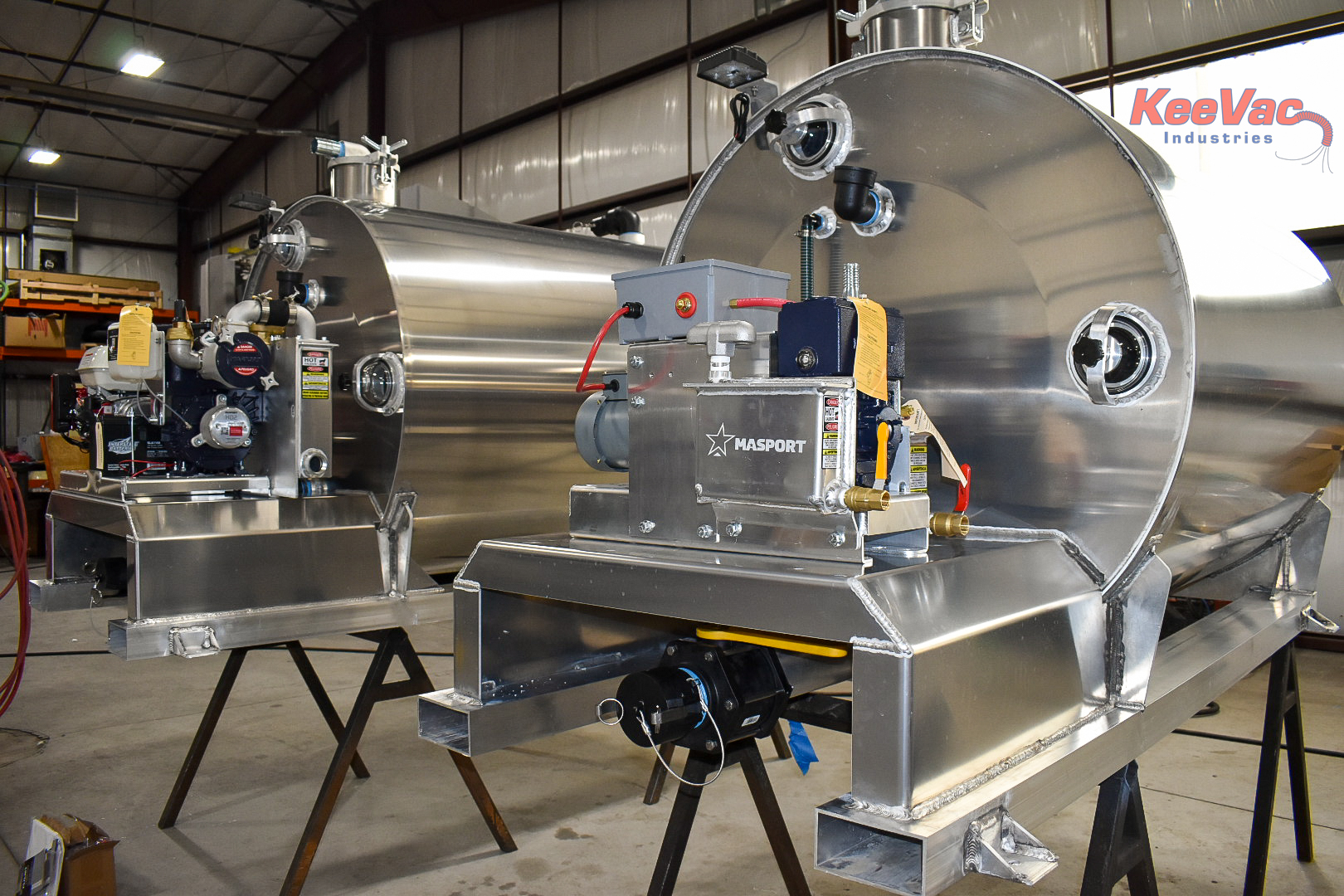
Vacuum truck tank baffles are the internal partitions that decide how liquid moves inside a loaded tank every time the driver brakes, turns, or climbs a grade. Built as perforated steel plates, bulkheads with cutouts, or drop-in modular spheres, baffles break one long column of liquid into smaller, slower-moving sections so the truck stays predictable under load. Without them, a partially filled tank is a large container where thousands of pounds of liquid can accelerate freely, whether the chassis underneath is a Freightliner, Peterbilt, Ford, or International.
Liquid hauling is never static. The fluid is always moving relative to the vehicle, and it transfers force to the frame, suspension, and tires in ways a solid payload never would. Understanding that force, and how baffle design reduces or amplifies it, matters to anyone specifying, buying, or operating a unit from KeeVac Industries or any other builder.
How Vacuum Truck Tank Baffles Control Liquid Surge
When a vacuum truck accelerates from a stop, the liquid lags behind because of inertia and presses toward the rear of the tank. When the driver brakes, that same mass surges forward. In a left turn it shifts to the right. A tank carrying several thousand gallons holds a moving mass that can hand its kinetic energy to the chassis almost instantly during any change in speed or direction.
The surge is not a single event. After the first wave strikes the front wall it rebounds toward the rear, and that back-and-forth motion continues until friction and tank geometry absorb it. Baffles interrupt the cycle. Their openings are sized to slow liquid transfer rather than permit free flow, so a wave loses energy as it passes through each partition and arrives at the next compartment with less speed and less force.
What Happens Inside an Unbaffled Tank
In an unbaffled tank the wave travels the full length of the shell unimpeded. On a long run with repeated braking and acceleration, the driver is constantly managing a load that works against the intended direction of travel. The early warning signs are easy to miss until something goes wrong:
- Cab shake that increases as the tank empties out
- Premature tire, brake, and suspension wear from repeated shock loading
- Steering response that feels light or unpredictable during turns
- A noticeable push from the load during hard stops
Why Fill Level and Liquid Density Matter
Partially filled tanks give liquid room to build momentum before it strikes a wall. The Federal Motor Carrier Safety Administration reports that 63% of cargo tank rollover crashes involved partial loads, and it tells drivers to understand the slosh and surge effect of liquid loads. A half-full tank can behave more aggressively than a nearly full one for exactly this reason.
Density adds another variable. Thin leachate moves fast and rebounds quickly, while heavy septic sludge, grease trap waste, or industrial slurry moves more slowly but carries more mass per gallon, so the force reaching the frame is larger. Weight per gallon changes with solids content, temperature, and composition, so operators should not assume a single figure applies to every material they haul. Drivers should adjust following distance, braking, and cornering speed to what is in the tank and how full it is.
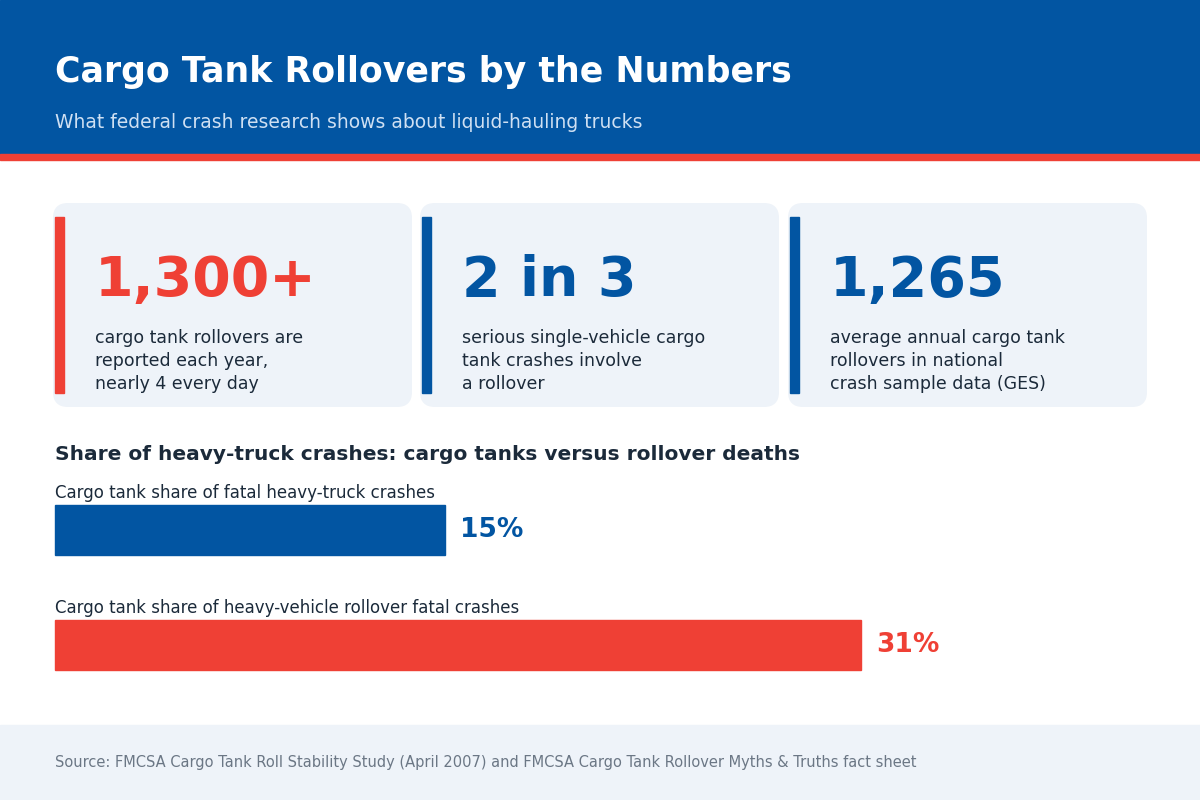
Source: FMCSA Cargo Tank Roll Stability Study
Baffled and Unbaffled Tank Designs Compared
Unbaffled tanks, often called smoothbore tanks, have one real operational advantage: they are easier to clean. There are no internal ledges, crevices, or extra welds to trap solids, so a pressure wash or jetting cycle clears the interior efficiently. Some slide-in vacuum units are configured this way because the work involves short, low-speed routes where surge forces are milder and fast turnaround matters more.
Baffled tanks divide the liquid into compartments. The partitions usually have cutouts at the bottom for drainage and cleaning, but those openings are sized to slow movement. Tank geometry also plays a role. Dished heads, elliptical or round cross-sections, and the placement of sumps and cleanout ports all influence how liquid settles at rest and moves in transit, so a well-engineered baffled tank accounts for all of them, not only the partitions.
Choosing Vacuum Truck Tank Baffles for Your Routes and Materials
The right choice depends on what you haul, how far you drive, and how you weigh handling margin against cleaning time. Crews servicing restaurants with grease trap vacuum trucks, for example, deal with sticky solids that make cleaning a bigger factor, while operators running long highway legs with partial loads benefit most from surge control.
| Factor | Baffled Tank | Smoothbore Tank |
|---|---|---|
| Surge control | Waves lose energy at each partition | Liquid travels the full tank length unimpeded |
| Cleaning | More crevices and welds to flush and inspect | Faster to clean and easier to inspect |
| Stiffness under vacuum | Partitions can add internal stiffness, depending on design | Relies on shell thickness and external rings |
| Best fit | Highway runs, partial loads, heavy or variable materials | Short, slow routes where cleanability is the priority |
Braking, Cornering, and Rollover Stability
Federal crash research shows that most cargo tank rollovers involve a chain of events rather than one cause. The FMCSA fact sheet notes that driver error is involved in about 78% of rollovers, and that over half happen on straight roads. Liquid movement is one of the conditions in that chain, and it is the one baffles are built to manage.
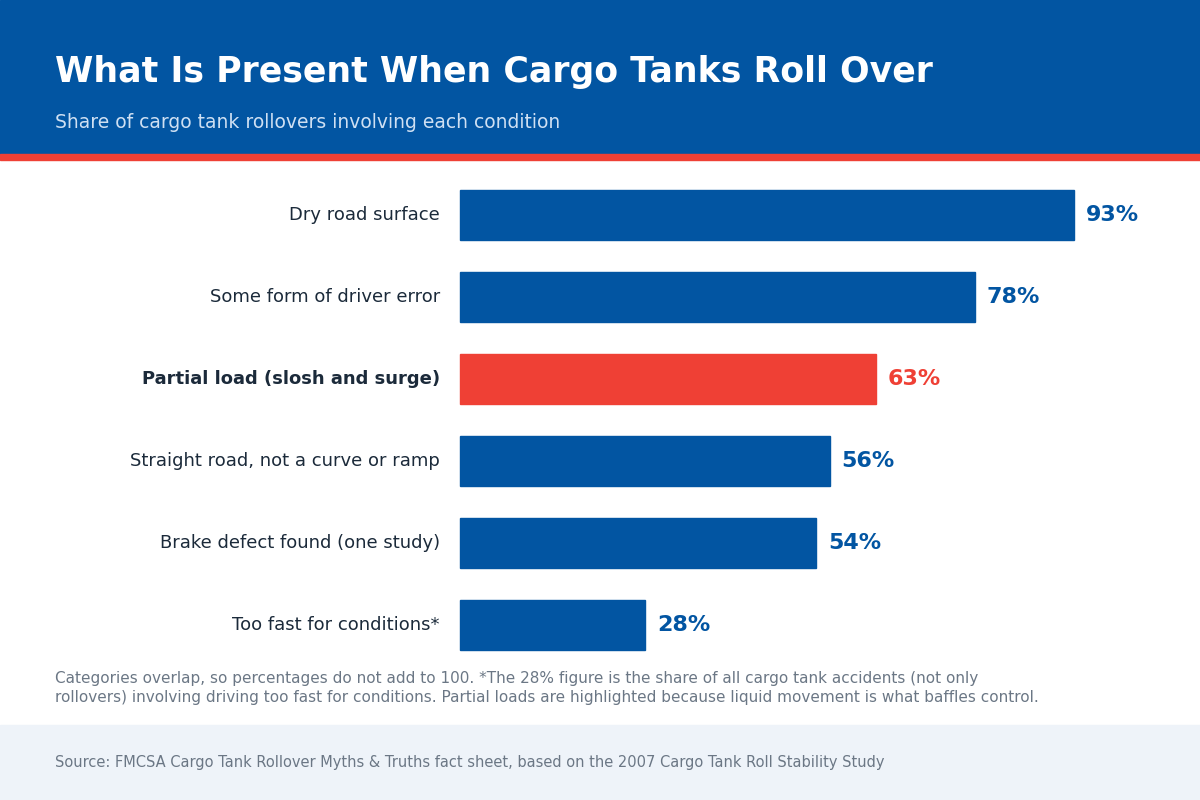
Source: FMCSA Cargo Tank Rollover Myths and Truths
Braking and Stopping Control
When the brakes are applied, the truck slows but the liquid keeps moving forward and pushes on the front wall. That adds momentum at the moment the driver is trying to remove it and lengthens the distance needed to stop. Baffles slow the liquid at each partition, so the energy reaches the front wall in smaller pulses instead of one concentrated wave. No reliable public figure quantifies the stopping distance difference between baffled and unbaffled tanks under identical conditions, so treat any specific percentage with skepticism unless it comes from a controlled test on your own configuration.
Cornering and Lateral Stability
In a turn, centrifugal force pushes liquid toward the outside, which raises the effective center of gravity on that side and unloads the inside wheels. Baffles reduce the speed and size of that shift, which gives the driver more time and margin. They do not remove it. Side-to-side movement can still occur in a baffled tank, which is why cornering speed and fill level stay in the driver’s hands.
Vehicle geometry sets the starting point. FMCSA describes rollover threshold as a function of center of gravity height, track width, and lateral force, and its simulation work estimated that lowering a trailer’s center of gravity by 3 inches could cut annual rollovers by about 12%, while a 6 inch wider track could cut them by about 17%.
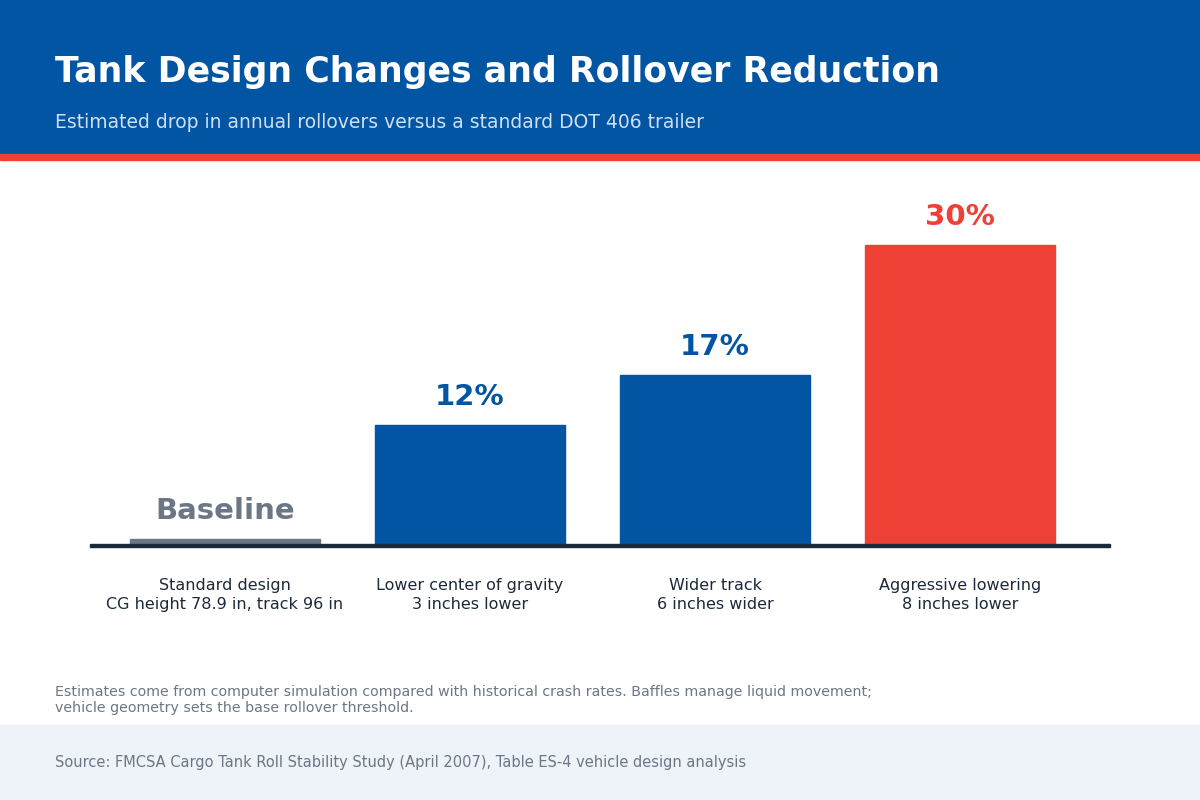
Source: FMCSA vehicle design analysis, Table ES-4
Properly specified baffling delivers practical benefits across the life of the truck:
- Less cab shake and operator fatigue on long routes
- Better traction during sudden maneuvers, because weight is not abruptly leaving the drive axles
- Reduced wear on brakes, suspension, and tires from repeated shock loading
- More driver margin in emergency stops and tight turns
The Structural Side of Baffles Under Vacuum
When the pump pulls a deep vacuum, atmospheric pressure presses inward on the whole shell. A tank that is not engineered for that load can buckle or collapse, and the failure tends to be sudden once the buckling threshold is reached. Builders resist it with shell thickness, formed heads, and stiffening rings. In many designs, internal baffles and bulkheads add stiffness as well, but how much depends on shell thickness, material, diameter, and the spacing of every stiffener.
That is why no single vacuum level can be called safe for every tank. Operators who regularly pull high vacuum, such as in industrial waste and excavation work, should discuss baffle spacing and shell thickness together with the builder rather than as separate line items. Protective devices matter too, and properly maintained pressure relief valves are the other half of keeping a tank inside its design limits.
Retrofit Options for Unbaffled Vacuum Tanks
Operators running unbaffled tanks who cannot replace the equipment have three main paths, each with real tradeoffs.
| Retrofit Method | How It Works | Tradeoffs |
|---|---|---|
| Welded baffles | Plates are welded to the shell by certified welders | Closest to factory baffling, but costly, slow, and requires confined-space entry and hot work controls |
| Modular baffle spheres | Nested HDPE spheres are dropped in through the manway | No cutting or welding, but sphere count depends on tank volume and manway size must be confirmed first |
| Removable baffle plates | Segmented plates are bolted or mechanically secured inside | Can be pulled for cleaning, but the hardware adds inspection and maintenance work |
Safety Requirements for Welded Retrofits
Welding inside a tank that has held hazardous waste means the tank must be thoroughly cleaned and gas-tested before any hot work begins. Entry is also regulated: OSHA treats many tanks as permit-required confined spaces, with written entry programs, atmospheric testing, and rescue planning under 29 CFR 1910.146. For many fleets, that overhead makes baffle spheres the more practical first step.
Baffle Inspection and Maintenance
Baffles are not install-and-forget parts. Liquid pounding against the plates, combined with corrosive materials such as septic waste, grease trap effluent, and industrial chemicals, degrades welds and metal over time. A cracked or detached baffle can become a loose obstruction that damages the shell or blocks the cleanout system.
Inspect baffles during every routine cleanout. With the tank empty, clean, and safely entered or viewed through the manway with good lighting, look for:
- Cracks or corrosion at the perimeter weld where each plate meets the shell, since that joint carries the most stress
- Rust pitting, loose hardware, or thinning on plates and brackets
- Cracked, warped, or degraded baffle spheres
- Baffle material that no longer suits the chemistry of what the tank carries, whether carbon steel, stainless steel, or HDPE
Fleets hauling grease trap waste, high-pH slurry, or acidic leachate should inspect more often than standard septic routes. A written vacuum truck maintenance schedule tied to each tank’s service history makes degradation trends visible before they become failures, and keeping replacement vacuum truck parts available shortens any downtime.
Specifying Baffles on a New or Custom Vacuum Truck
Baffle spacing, perforation sizing, and tank geometry should be matched to real route conditions, not chosen arbitrarily. When planning a build, bring these details to the conversation:
- The materials you haul and their typical density range
- Average fill level, since partial loads drive most surge problems
- Highway versus short-haul mix and typical grades
- Required vacuum depth and pump capacity
- How often the tank must be cleaned to a high standard
Teams planning custom vacuum truck builds can work through these tradeoffs early, and anyone still comparing options can speak with a vacuum truck specialist about chassis, tank size, and baffle configuration.
Frequently Asked Questions About Vacuum Truck Tank Baffles
What is the purpose of baffles in a vacuum tank?
Baffles are internal partitions that reduce liquid sloshing during transport. They slow the movement of fluid, dissipate energy across compartments, and help keep the truck stable. In some designs they also add stiffness to the tank structure.
Do baffles make a vacuum tank harder to clean?
Yes. Partitions create crevices and weld seams where debris can collect, so flushing takes more effort. For most septic, grease, and industrial work the surge control is worth the extra labor, and removable baffle spheres can be pulled out when a tank needs a deeper cleaning.
Can you retrofit an unbaffled vacuum tank with baffles?
Yes. Options include welded baffles installed by certified welders under confined-space entry procedures, drop-in modular baffle spheres, or removable bolted plates. The right choice depends on budget, manway size, and how much surge control your routes need.
How do baffles affect a vacuum truck’s braking?
They slow the forward surge of liquid when the brakes are applied, which reduces the extra momentum pushing the truck forward. Exact stopping distance differences between baffled and unbaffled tanks are not established in public research, but experienced operators notice the difference in vehicle control, especially on downhill grades.
Do tank baffles eliminate the risk of a rollover?
No. Baffles reduce how fast liquid shifts, but they do not change the truck’s high center of gravity, and side-to-side movement can still occur. Speed management, fill level, and attentive driving remain essential. The baffle buys margin, and the driver has to use it.
How often should baffles be inspected?
Inspect them at every routine tank cleanout, and more often when hauling corrosive materials such as grease trap waste, high-pH slurry, or acidic leachate. Pay particular attention to the weld where each plate meets the shell.
Request Your Custom Vacuum Truck Quote Today
Proper baffling is a core safety consideration for any serious liquid-hauling operation. Controlling surge protects your equipment, your drivers, and everyone sharing the road, and regular inspection keeps that protection working. Call (303) 789-9440 or request a quote tailored to your materials, routes, and vacuum requirements, and let the KeeVac team build a unit that supports your business with dependable parts availability and ongoing support.