Grease Trap Cleaning: Process, Frequency, and the Right Vacuum Truck
Every commercial kitchen depends on regular grease trap cleaning to keep fats, oils, and grease out of the sewer. When a trap or interceptor goes too long without service, grease hardens, solids pile up, and the result is slow drains, foul odors, backups, and fines. The fastest and cleanest way to clear a trap is a vacuum truck, which removes the grease cap, the water, and the settled solids in one sealed process.
A grease trap is a compact unit installed at or near the sinks, while a gravity grease interceptor is a larger tank, usually buried outside the building. Both work the same way. Wastewater slows down, grease floats to the top, solids settle to the bottom, and cleaner water moves on to the sewer. Both also fill up, and a vacuum truck is the equipment that empties them.
Why Grease Trap Cleaning Matters for Kitchens and Sewers
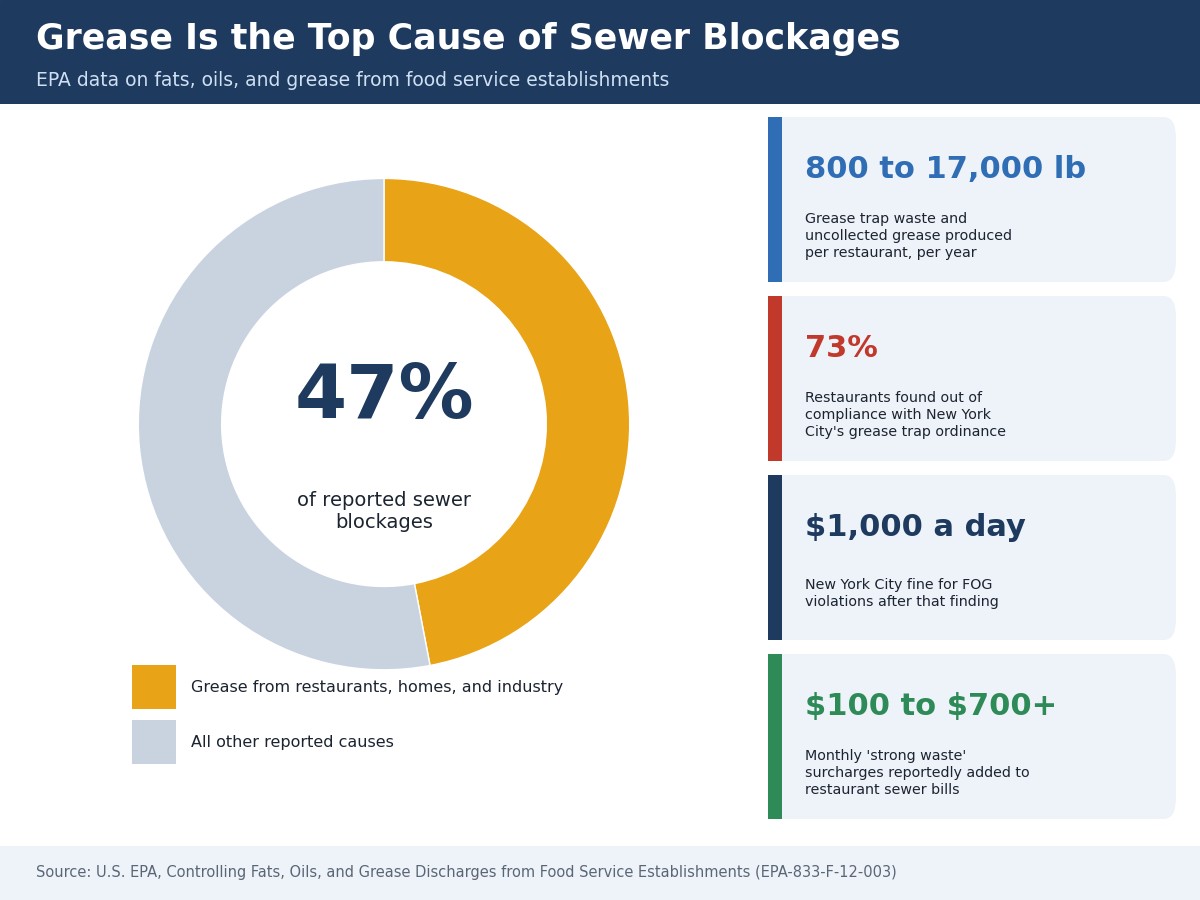
The scale of the problem is documented. The EPA’s 2004 Report to Congress on sewer overflows found that grease from restaurants, homes, and industrial sources is the most common cause of reported sewer blockages, at 47 percent, because grease solidifies and cuts the capacity of the pipe. EPA’s national pretreatment fact sheet adds that annual grease trap waste and uncollected grease can range from 800 to 17,000 pounds per restaurant, and that federal pretreatment rules at 40 CFR 403.5(b)(3) prohibit solid or viscous pollutants in amounts that cause obstruction.
Source: U.S. EPA, Controlling Fats, Oils, and Grease Discharges from Food Service Establishments
For a kitchen, the consequences land fast:
- Fines and surcharges. The EPA reports that one major city found a 73 percent non-compliance rate with its grease trap ordinance and responded with a $1,000-per-day fine for FOG violations, and that monthly “strong waste” surcharges of $100 to $700 or more are reportedly added to restaurant sewer bills.
- Backups and downtime. A blocked line can shut down dish stations and floor drains in the middle of service.
- Failed inspections. Inspectors check pump-out records and the condition of the trap.
- Higher repair costs. Grease that escapes the trap hardens in the building’s own drain line.
Why Grease Trap Cleaning Frequency Matters
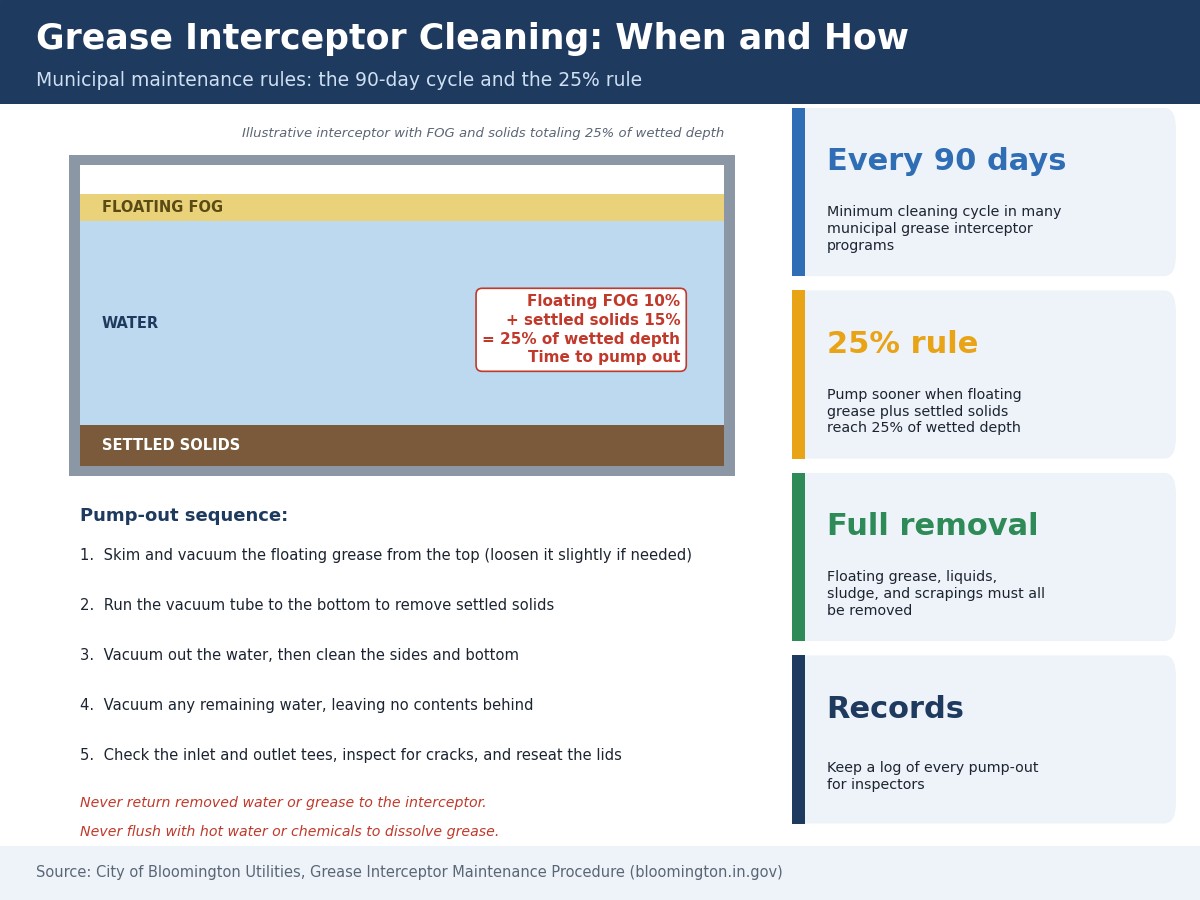
The EPA states that the maintenance frequency a device needs depends on how much FOG a kitchen generates and on the best management practices it follows. Local sewer authorities turn that guidance into a schedule. municipal grease interceptor maintenance procedures are typical: cleaning at least every 90 days, or sooner when the floating grease and settled solids together reach 25 percent of the wetted depth, measured from the water surface to the bottom of the tank.
Source: City of Bloomington Utilities, Grease Interceptor Maintenance Procedure
The 25 percent rule matters because it is a limit on performance, not just a calendar. A busy kitchen with heavy frying can reach 25 percent well before 90 days, and a light-use kitchen may stay under it longer. Operators who track levels at every stop, rather than cleaning on a fixed date, protect both the customer and the sewer. Always confirm the exact interval with the local authority, since the rules vary by jurisdiction.
Grease Trap Cleaning With a Vacuum Truck, Step by Step
A proper service follows the same order at every stop. Skipping steps leaves grease behind, which shortens the time until the next cleaning is due.
- Set up the site. Position the truck close to the access lid, place cones and spill containment, and confirm the hose will reach.
- Open the lids safely. Remove the covers, ventilate the opening, and check the atmosphere before work begins. Never enter the tank.
- Remove the grease cap. Vacuum the floating grease from the surface, loosening it slightly if it has hardened.
- Pull the settled solids. Run the vacuum tube to the bottom of the interceptor and remove the sludge.
- Vacuum out the water. Take out the remaining liquid until nothing is left to return to the tank.
- Clean the surfaces. Scrape and rinse the sides and bottom, then vacuum the rinse water out as well.
- Inspect the hardware. Check the inlet and outlet tees, look for cracks or defects, and make sure the lids reseat tightly.
- Document and haul. Record the pump-out for the customer and inspectors, then haul the load to an approved disposal facility.
Compared with manual scooping, a vacuum truck keeps the waste sealed, finishes the job faster, and limits the crew’s contact with grease and wastewater. It also makes a complete pump-out realistic, which is what many local rules require.
Grease Trap Vacuum Systems and How They Handle Thick Grease
A vacuum truck works by removing air from a sealed tank so that atmospheric pressure pushes the material up the hose and into the tank. The pump never has to handle the grease directly, which is why vacuum systems cope so well with thick caps and sludge. Protective devices such as an overfill shutoff and a moisture trap keep liquid from reaching the pump, and the truck unloads by gravity or by pressure at the disposal site.
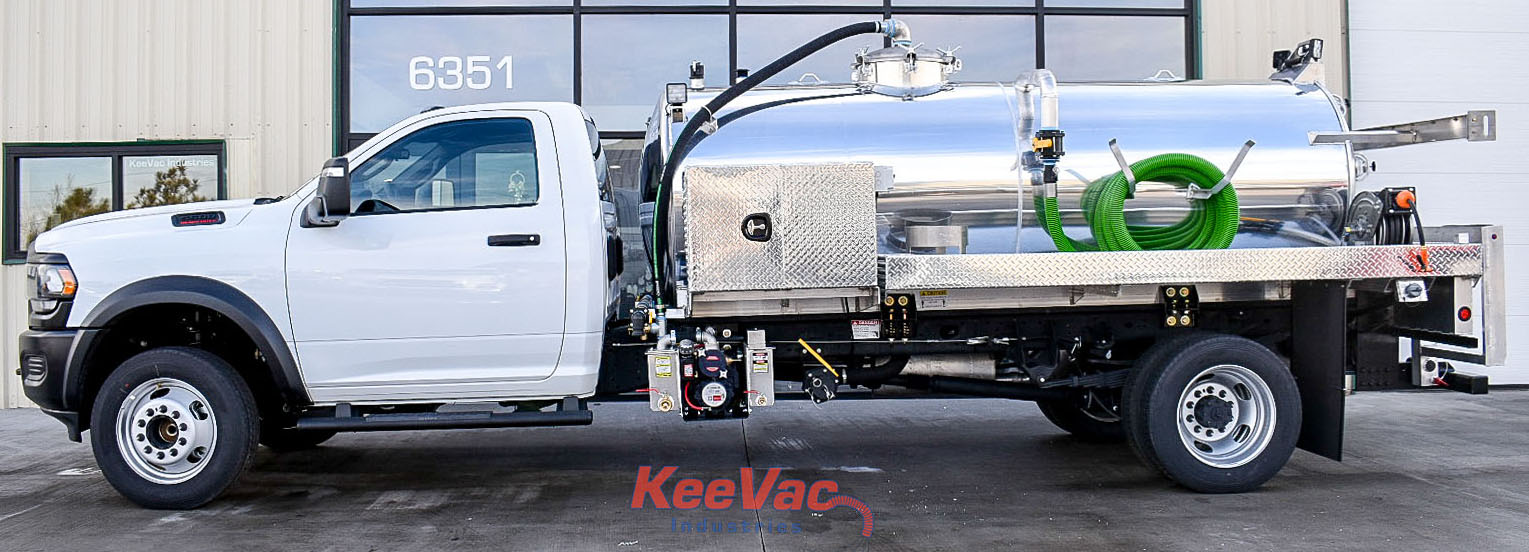
Grease puts more demand on the system than water does. Cold grease is thick, hoses are long, and interceptors can be deep, so a strong pump, a large-diameter hose, and airtight couplings all matter. For reference, a current KeeVac 2,500-gallon build pairs an aluminum vacuum tank with a 338 CFM vacuum pump.
What a Grease Trap Cleaning Truck Needs: Tank, Pump, and Hose
The right truck depends on the size of the traps you service, the distance to the disposal facility, and how many stops you plan to finish before unloading. These are the features that decide productivity on grease routes.
| Feature | Why it matters for grease | What to ask about |
|---|---|---|
| Tank capacity | A complete pump-out means the tank must hold the whole interceptor | Largest interceptor you service and stops per load |
| Vacuum pump | Thick grease and sludge need strong, steady vacuum | Pump size in CFM and duty rating |
| Hose and reel | Deep interceptors need reach and a wide bore | Hose length, diameter, and reel placement |
| Tank material | Grease residue and cleaning water attack poor materials | Aluminum versus steel and weight on the chassis |
| Level indicator and overfill shutoff | Prevents overfilling and protects the pump | Sight glass, float valve, and moisture trap |
| Offload system | Faster unloading means faster turnaround at the disposal site | Gravity discharge, pressure offload, and valve size |
| Chassis | Carries a full tank of grease every day | Axle ratings, brakes, and engine service access |
Tank Size and Complete Pump-Outs Per Load
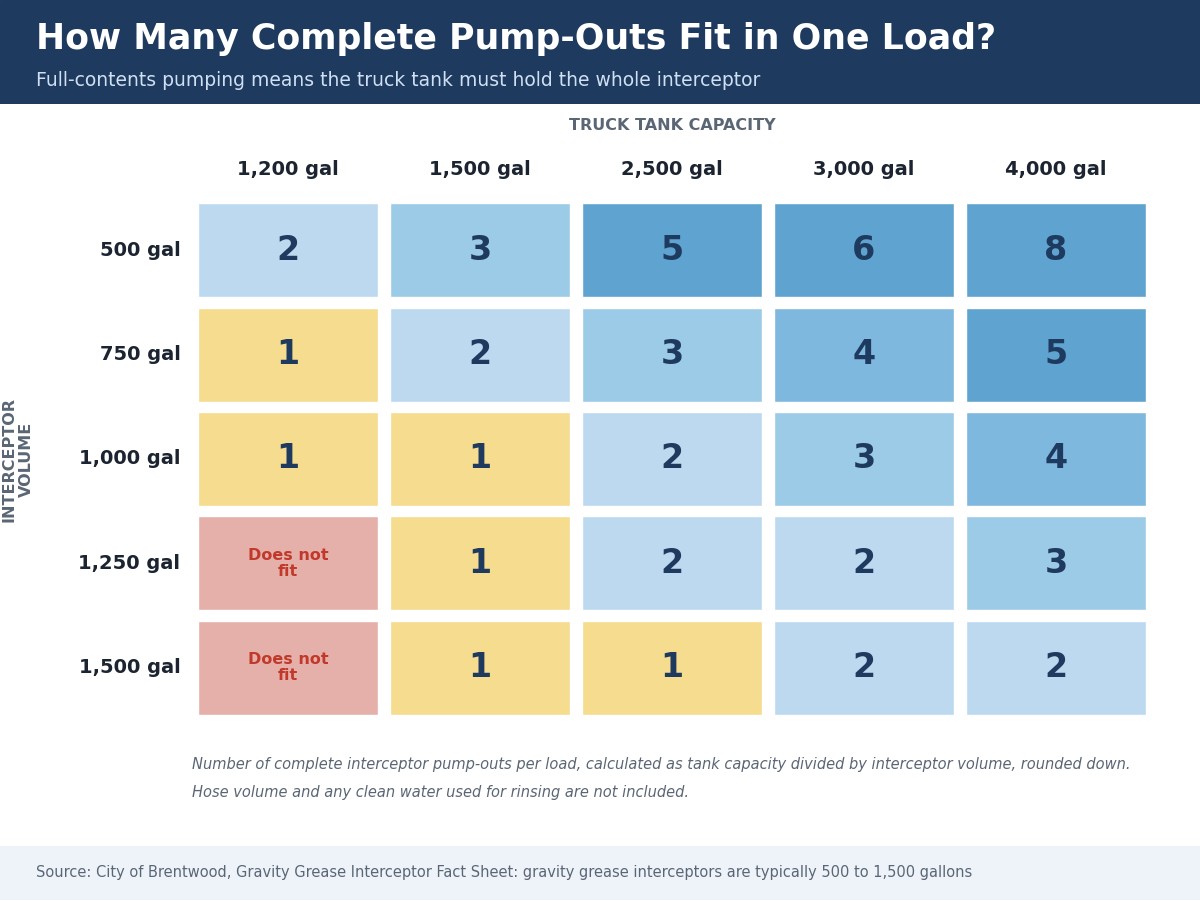
Tank size is the specification most operators underestimate. According to a city fact sheet on gravity grease interceptors, gravity grease interceptors are typically 500 to 1,500 gallons, and many agencies require the whole contents to be removed. That means a truck whose tank is smaller than your largest interceptor simply cannot do the job in one pass.
Source: City of Brentwood, Gravity Grease Interceptor Fact Sheet
The grid shows why a bigger tank pays off on busy routes. A 1,200-gallon tank cannot take a full 1,250-gallon interceptor, while a 3,000-gallon tank completes two. Pair that math with the distance to your disposal facility and you can estimate how many stops each load covers and how many loads a crew needs per day.
Grease Trap Cleaning Equipment: Hoses, Reels, and Accessories
The tank and pump get the attention, but the accessories decide how smooth each stop feels. Useful equipment includes:
- Hose lengths and reels matched to the deepest and farthest interceptors on the route
- Tools for scraping the sides and bottom of the tank
- Spill containment, absorbent pads, and a clean-up kit on every truck
- Pressure relief valves that protect the tank during vacuum and pressure cycles
- A sight glass or level indicator so the operator always knows how full the tank is
|
Running grease trap routes? Tank size and pump package decide how many stops your crew finishes before an offload. KeeVac builds FOG-ready trucks on the chassis your routes need.
|
Choosing the Right Truck for Your Grease Routes
Full-Size Grease Trucks
High-volume routes and large interceptors call for a full-size truck with a big tank and a strong pump. These trucks hold several complete pump-outs per load and carry the hose lengths needed for deep tanks. KeeVac’s FOG-ready grease truck builds are available on chassis from Ford, Chevrolet, Ram, International, Peterbilt, Freightliner, Mack, Isuzu, and Kenworth.
Slide-In Vacuum Units
Smaller operations often start with a unit that rides in the bed of a pickup. Aluminum slide-in vacuum units are light, quick to install, and easy to remove when the truck is needed for other work. They suit smaller traps and tight access, with the trade-off of more trips to the disposal site.
Small Traps and Food Truck Service
Food trucks, small cafes, and other low-volume kitchens have small traps that do not need a large tank. For that work, compact equipment such as small grease pump-out carts can be a practical fit, especially where a truck cannot reach the trap.
Dual-Use Trucks for Grease and Septic Work
Many haulers run grease routes alongside other liquid-waste work. Because the core hardware is the same, a truck can often be configured for both jobs, which spreads its cost over more billable hours. If that fits your business, look at septic pump truck configurations with an eye to tank material, hose setup, and cleaning between waste types.
Custom Configurations
No two routes are identical. Hose length, reel placement, pump size, compartment layout, and tool storage can all be tailored to how your crew works. When a stock build is close but not exact, custom truck configurations let you match the truck to your stops rather than the other way around.
Safety for Grease Trap Cleaning Crews
Grease interceptors hold decomposing waste, and the EPA notes that hydrogen sulfide generation in the sewer system can cause damage. For crews, the same gas is a safety risk at the tank opening. Good habits are simple and should be non-negotiable:
- Work from outside the tank and never enter an interceptor to clear a blockage or retrieve a tool
- Wear a personal gas monitor and ventilate the opening before and during service
- Use gloves, eye protection, and slip-resistant footwear, and keep a spill kit within reach
- Place cones and keep lids and hoses out of traffic paths
- Complete a manifest for every load so waste is traceable to an approved disposal facility
OSHA’s permit-required confined space standard, 29 CFR 1910.146 requires employers to evaluate their workplaces for permit-required confined spaces, which is why entry into a tank should never be improvised.
Keeping a Grease Trap Truck Ready for Every Route
Grease is hard on equipment. Residue builds up in hoses, valves, and tanks, and a truck that is not rinsed and inspected regularly loses vacuum and wastes time. A short routine goes a long way:
- Before each shift: check pump oil, inspect hoses and gaskets, and test the overfill shutoff
- After each load: drain the moisture trap, rinse the hose and tank, and wipe down valves and couplings
- Weekly: grease fittings, inspect lid seals, and check the PTO and hydraulic fluid
- Each season: follow the pump maker’s service schedule and replace worn vanes, seals, and hoses
Keep the pump operating manuals in the cab so service intervals are never a guess.
For inspection routines you can adapt to a fleet, KeeVac’s truck maintenance resources are a useful starting point.
When a hose, gasket, valve, or pump component wears out, replacement pump, hose, and valve parts keep downtime short and the route on schedule.
Grease Trap Cleaning FAQs
How often should grease trap cleaning be done?Many municipal programs require grease interceptors to be cleaned at least every 90 days, or sooner when floating grease and settled solids reach 25 percent of the wetted depth. The EPA notes that the right frequency depends on how much FOG a kitchen produces and which best management practices it follows, so confirm the schedule with the local sewer authority. |
What is the 25 percent rule for grease traps?The 25 percent rule says a grease trap or interceptor must be pumped out when the combined depth of floating grease and settled solids reaches 25 percent of the wetted depth, even if the regular cleaning date has not arrived. It protects the trap from losing its ability to separate grease from wastewater. |
Can a grease trap be partially pumped?Many local programs require a complete pump-out of the floating grease, liquids, sludge, and scrapings, and they do not allow removed water or grease to be returned to the interceptor. Always check the local ordinance, because some jurisdictions are stricter than others. |
What size truck do I need for grease trap cleaning?The tank has to hold the full contents of the largest interceptor you service. Gravity grease interceptors are typically 500 to 1,500 gallons, so a 2,500-gallon tank can handle two complete 1,000-gallon pump-outs or one 1,500-gallon pump-out per load. Smaller slide-in units suit smaller traps and tighter access. |
Can a slide-in vacuum unit handle grease trap cleaning?Yes, for smaller traps and routes with limited access. A slide-in unit fits in a pickup bed and is easy to deploy, but its tank is smaller, so it makes more trips to the disposal site than a full-size truck. Match the tank to your largest trap and your daily stop count. |
What affects the cost of grease trap pumping?Trap or interceptor volume, service frequency, how much grease and solids have accumulated, distance to the disposal facility, and disposal fees all affect the price. According to the EPA, kitchens that follow best management practices can reduce how often they need service. |
Does KeeVac clean grease traps?No. KeeVac builds the vacuum trucks and slide-in units that licensed grease haulers use. A kitchen that needs a trap serviced should hire a licensed grease hauler. |
Spec a Truck for Your Grease Trap Cleaning Routes
The best way to size a truck is to start with your trap sizes, daily stops, and disposal distances. KeeVac’s full equipment lineup includes grease, septic, portable restroom, and custom builds, and every unit can be configured around your routes.
If you want help choosing a tank, pump, and chassis, you can talk with a truck specialist and describe your jobs. The team will recommend a configuration that fits.
Many operators spread the cost of a new truck over time, and equipment financing options can put a unit to work while it earns its keep.
|
Ready to spec a grease trap cleaning truck? Tell us your typical trap sizes, daily stops, and disposal distances, and we will recommend a tank, pump, and chassis to match.
|